Research library / Compounds
What is ?
The first 29 of human GHRH’s 44 amino acids, with nothing added.
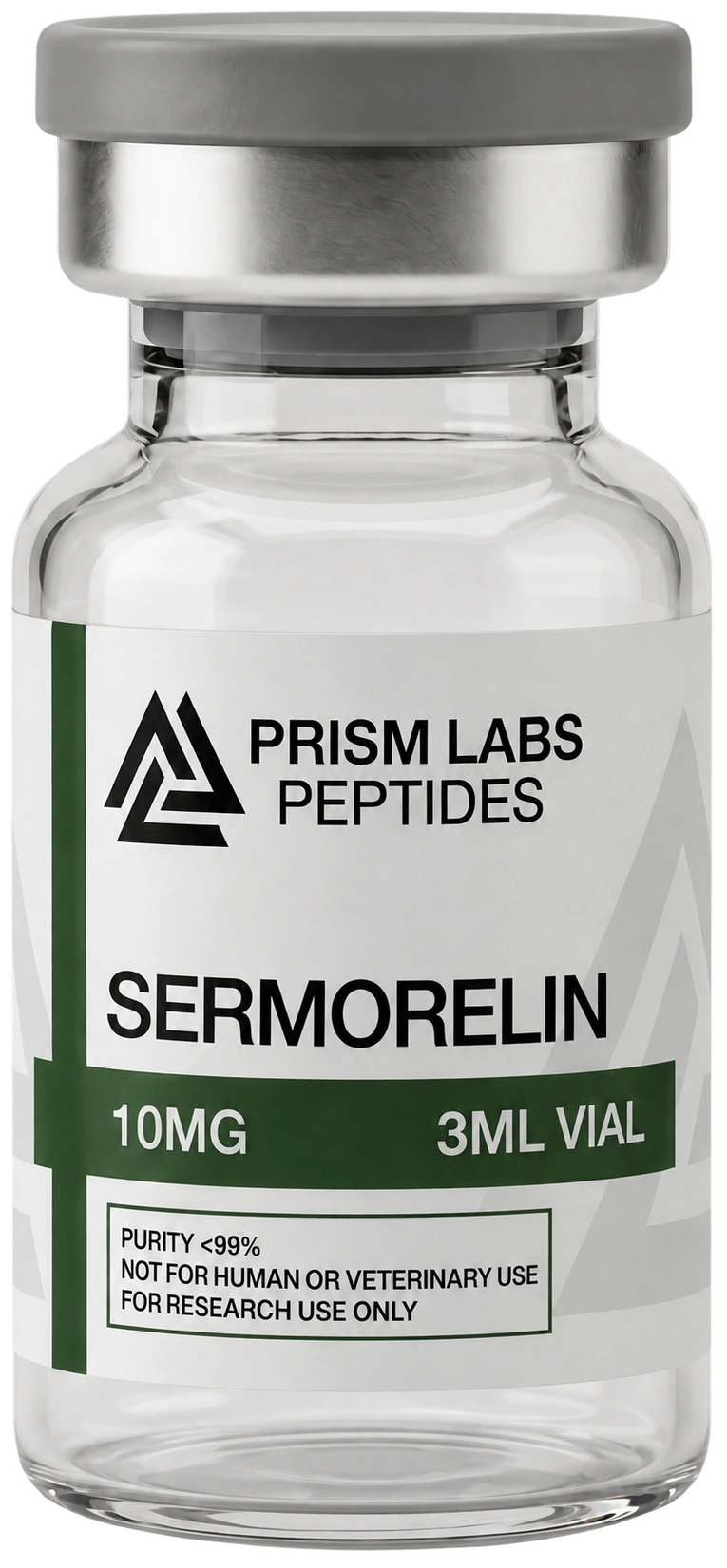
is a synthetic peptide made of the first 29 amino acids of human growth hormone-releasing hormone (GHRH), the hormone that signals the pituitary to release growth hormone. In the 1980s, researchers found that this shorter chain keeps much of the full hormone’s activity in laboratory tests. Prism Labs supplies it as a 10 mg lyophilized vial.
01
What it is
It is a single chain of 29 amino acids, YADAIFTNSYRKVLGQLSARKLLQDIMSR, identical to the start of the 44-amino-acid human hormone. Like the hormone, it ends in an amide (–NH2). Nothing else is changed: no added groups and no substituted amino acids.
The reference record lists the formula C149H246N44O42S and a molecular weight of about 3,358 g/mol (PubChem CID 16132413). Papers also write it as GHRH(1–29) or GRF(1–29), from the hormone’s older name, growth hormone-releasing factor.
Sources: [1] PubChem · reference structure · [2] Science · 1982 · [3] Biochemical and Biophysical Research Communications · 1984
02
Where it came from
Its parent hormone was identified in 1982 in a pancreatic tumor that had caused acromegaly, a condition of excess growth hormone. Roger Guillemin’s group reported the 44-amino-acid sequence and showed that a synthetic copy was fully active.
Chemists then trimmed the chain from its far end. In 1984 rat pituitary-cell experiments, the 1–29 amide kept about half the full hormone’s potency. Shorter fragments still worked, but only at far higher amounts, and at 19 residues activity vanished.
A 1999 review called the 1–29 fragment the shortest synthetic peptide with the full biological activity of GHRH.
Sources: [2] Science · 1982 · [3] Biochemical and Biophysical Research Communications · 1984 · [4] BioDrugs · 1999
03
A template for other analogues
In plasma, an enzyme called dipeptidyl peptidase IV (DPP-IV) cuts GHRH between its second and third amino acids. A 1989 study found the same cut in the 1–29 amide, and that swapping either of the first two amino acids for its mirror-image (D-) form blocked it.
was built on this template: four amino acids substituted, plus, in the 2005 paper that introduced it, a group that binds albumin in the blood, called DAC. The versions with and without DAC are separate compounds.
Its blend with : What is / ?
Sources: [5] Journal of Clinical Investigation · 1989 · [6] Endocrinology · 2005 · [7] Drug Testing and Analysis · 2021
04
vs
The two are often compared. keeps all 44 amino acids and adds a small chemical group to the first; stops at 29.
Side by side: vs , compared. Full profile: What is ?
Sources: [2] Science · 1982
05
What researchers have studied
Its literature runs from 1980s peptide chemistry to modern drug testing:
- How chain length changes growth hormone release from rat pituitary cells.
- Clinical studies of pituitary growth hormone release, reviewed in 1999.
- Anti-doping detection of four GHRH analogues and their breakdown products in urine, including this peptide minus its first two amino acids (2021).
These are observations in laboratory models. They are not evidence about any use in people.
Sources: [3] Biochemical and Biophysical Research Communications · 1984 · [4] BioDrugs · 1999 · [7] Drug Testing and Analysis · 2021
06
How it is supplied and stored
ships as a lyophilized (freeze-dried) powder in 10 mg vials. The powder is stable at room temperature in transit. For lab use it is reconstituted with bacteriostatic water such as .
Concentration is content divided by volume: 10 mg in 2 mL gives 5 mg per mL. The reconstitution calculator handles other combinations.
For storage before and after reconstitution, see how to store lyophilized peptides.
07
How to verify a batch
Every lot has its own certificate of analysis from an independent lab. Read three results separately:
- Identity: confirms the expected compound was detected.
- Purity: the share of the measured material that is the intended compound.
- Content: the amount measured, compared with the label.
Then match the lot number on your vial or bottle to the report, and use the report’s verification link to confirm it with the testing lab. Step by step: how to read a peptide COA.
A little more clarity
Questions, answered
What is ?
A synthetic copy of the first 29 amino acids of human growth hormone-releasing hormone, ending in an amide. It is often written GHRH(1–29).
Is a peptide?
Yes. It is a single chain of 29 amino acids, about 3,358 g/mol.
How is different from ?
keeps all 44 amino acids of GHRH and adds a trans-3-hexenoyl group to the first. is the first 29, with nothing added.
Is the same as or ?
No. uses the same 29 amino acids with four of them substituted. is a five-residue peptide that works through a different receptor.
Is it for human use?
No. Prism Labs sells it for laboratory research use only.
Follow the evidence
Sources & reading notes
Open the original record for its methods and limitations. The sources below do not certify the supplied product or its finished formulation.
- PubChem · reference structure ↗
The structure referenced in the product specifications; not a measurement of the supplied batch.
- Science · 1982 ↗
Isolation and 44-amino-acid sequence of the hormone from a pancreatic tumor.
- Biochemical and Biophysical Research Communications · 1984 ↗
Activity of fragments shortened from the end of the chain, including the 1–29 amide, in rat pituitary cells.
- BioDrugs · 1999 ↗
Review of the 1–29 analogue’s pharmacology and clinical literature.
- Journal of Clinical Investigation · 1989 ↗
Where the plasma enzyme DPP-IV cuts GHRH and the 1–29 amide, and how D-amino acids block it.
- Endocrinology · 2005 ↗
Albumin-binding analogues of the 1–29 sequence; introduces the four-substitution compound.
- Drug Testing and Analysis · 2021 ↗
Anti-doping detection of four GHRH analogues and their metabolites, including the 3–29 amide.
Prepared by Prism Labs from the linked source records and public product documentation. Research context only; not a preparation protocol or a claim about outcomes. Send a source correction.
Keep exploring
More from the research library.
A lipid-linked peptide built to act on two related hormone receptors at once.
Read the article ↗Compounds
Part of the hormone α-MSH, rebuilt in 1989 as a cyclic seven-residue peptide to study melanocortin receptors.
Read the article ↗Compounds
The last 15 amino acids of human growth hormone, plus one tyrosine.
Read the article ↗