Research library / Compounds
What is ?
Part of the hormone α-MSH, rebuilt in 1989 as a cyclic seven-residue peptide to study melanocortin receptors.
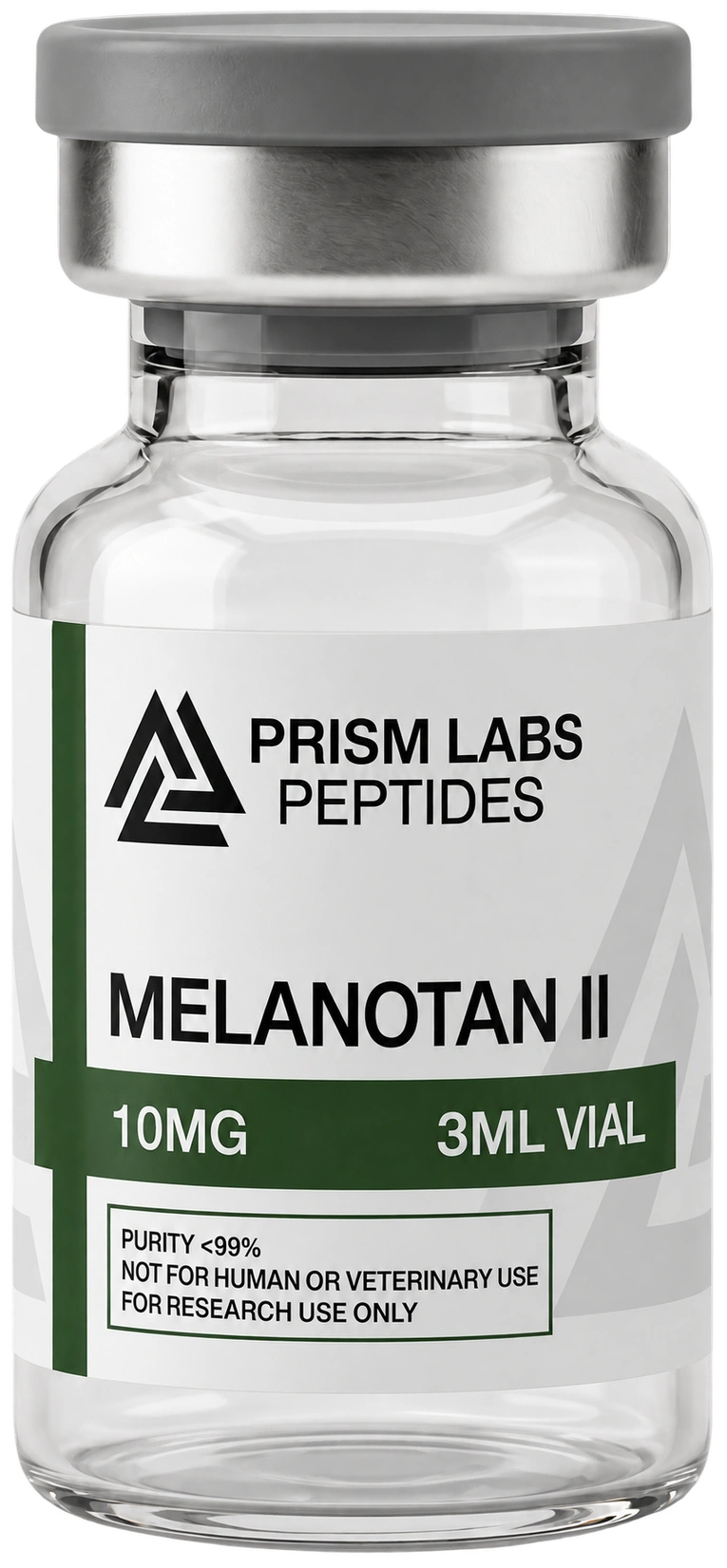
is a synthetic cyclic peptide of seven amino acids, built from part of alpha-melanocyte-stimulating hormone (α-MSH). Chemists at the University of Arizona designed it in 1989 to study melanocortin receptors, and it activates four of the five subtypes. was later developed from it. Prism Labs supplies it as a 10 mg lyophilized vial.
01
What it is
Its structure is Ac-Nle-cyclo[Asp-His-D-Phe-Arg-Trp-Lys]-NH2: an acetylated norleucine followed by a six-residue ring. A lactam bridge, an amide bond between the side chains of aspartic acid and lysine, closes the ring. The chain ends in an amide (–NH2).
The reference record lists the formula C50H69N15O9 and a molecular weight of 1024.2 g/mol (PubChem CID 92432). The ring is made of 23 atoms. Two residues, norleucine and D-phenylalanine, are outside the standard twenty, so the identity result on the COA is the reliable check.
Sources: [1] PubChem · reference structure · [2] Journal of Medicinal Chemistry · 1989 · [3] Beilstein Journal of Organic Chemistry · 2008
02
Where it came from
α-MSH is a 13-residue peptide hormone: Ac-Ser-Tyr-Ser-Met-Glu-His-Phe-Arg-Trp-Gly-Lys-Pro-Val-NH2. In the 1980s, researchers at the University of Arizona designed analogues that were more potent, longer acting and harder for enzymes to break down.
In 1989 Al-Obeidi, Hruby, Hadley and colleagues used molecular-dynamics models to design a series of cyclic analogues of positions 4 to 10. Four changes turn that stretch into this compound: norleucine for methionine, aspartic acid for glutamic acid, D-phenylalanine for phenylalanine and lysine for glycine.
They tested the series on frog and lizard skin, the standard assays of the time for pigment-cell (melanocyte) receptors. In the lizard assay, the aspartic acid–lysine ring was about 90 times as potent as α-MSH, and its effect lasted longer. It keeps positions 6 to 9 of the hormone, His-Phe-Arg-Trp, with D-phenylalanine in place of phenylalanine. The last three residues, Lys-Pro-Val, are left out; they are studied on their own as .
A 2006 history by two of the Arizona researchers names two analogues from this work that were patented and tested clinically: a linear one and this cyclic, shortened one. A pilot phase I study in three volunteers was published in 1996. Palatin Technologies later developed a new analogue from it, .
Sources: [2] Journal of Medicinal Chemistry · 1989 · [4] Peptides · 2006 · [5] Life Sciences · 1996
03
How it differs from
The two share the same seven residues, in the same order, closed into the same 23-atom ring. They differ at one end of the chain:
- ends in an amide (–NH2). ends in a free acid (–OH).
- Formulas: C50H69N15O9 at 1024.2 g/mol, against C50H68N14O10 at 1025.2 g/mol. Swapping –NH2 for –OH removes one nitrogen and one hydrogen and adds one oxygen.
- Each has its own literature. Results for one are not results for the other.
Because their weights differ by only about 1 g/mol, check the product name and the identity result on the COA, not the weight alone. For the sibling compound, see What is ?
Sources: [1] PubChem · reference structure · [6] PubChem · reference structure · [4] Peptides · 2006
04
What researchers have studied
Its literature centers on melanocortin receptors, a family of five subtypes:
- MC1R, the α-MSH receptor on pigment cells, cloned in 1992. It is the subtype studied in pigmentation research.
- MC3R and MC4R in the brain, and MC5R in other tissues. A 1995 paper notes that these three and MC1R all respond to α-MSH and to this analogue, while MC2R responds only to ACTH.
- Selectivity: in the same paper, putting a bulkier residue in place of D-phenylalanine made the ring a potent MC4R blocker that still activated MC1R and MC5R.
- Ring chemistry: a 2008 paper reported the first solution-phase synthesis, closing the lactam between lysine and aspartic acid. A 2022 study replaced the lactam with other linkers, and one version acted selectively at human MC1R, unlike the parent.
Modified versions are separate compounds, so their results are not properties of this peptide. These are observations in laboratory models. They are not evidence about any use in people.
Sources: [7] Science · 1992 · [8] Journal of Medicinal Chemistry · 1995 · [3] Beilstein Journal of Organic Chemistry · 2008 · [9] Journal of Medicinal Chemistry · 2022
05
How it is supplied and stored
ships as a lyophilized (freeze-dried) powder in 10 mg vials. The powder is stable at room temperature in transit. For lab use it is reconstituted with bacteriostatic water such as .
Concentration is content divided by volume: 10 mg in 2 mL gives 5 mg per mL. The reconstitution calculator handles other combinations.
For storage before and after reconstitution, see how to store lyophilized peptides.
06
How to verify a batch
Every lot has its own certificate of analysis from an independent lab. Read three results separately:
- Identity: confirms the expected compound was detected.
- Purity: the share of the measured material that is the intended compound.
- Content: the amount measured, compared with the label.
Then match the lot number on your vial or bottle to the report, and use the report’s verification link to confirm it with the testing lab. Step by step: how to read a peptide COA.
A little more clarity
Questions, answered
What is ?
A synthetic cyclic seven-residue analogue of α-MSH, designed at the University of Arizona in 1989 to study melanocortin receptors.
How is different from ?
was developed from it later. Both have the same seven residues and the same ring, but ends in an amide (–NH2) and ends in a free acid (–OH).
Which receptors does it act on?
Melanocortin receptors. Papers describe it activating MC1R, MC3R, MC4R and MC5R, the four subtypes that respond to α-MSH, with little selectivity among them.
Is the same as α-MSH?
No. α-MSH is a natural 13-residue hormone. This is a shorter synthetic version of positions 4 to 10, with four amino-acid changes and a lactam ring.
Is it for human use?
No. Prism Labs sells it for laboratory research use only.
Follow the evidence
Sources & reading notes
Open the original record for its methods and limitations. The sources below do not certify the supplied product or its finished formulation.
- PubChem · reference structure ↗
The structure referenced in the product specifications; not a measurement of the supplied batch.
- Journal of Medicinal Chemistry · 1989 ↗
Design of cyclic lactam analogues of α-MSH, including this ring, with skin-assay potencies.
- Beilstein Journal of Organic Chemistry · 2008 ↗
First solution-phase synthesis, including the lactam ring closure.
- Peptides · 2006 ↗
History of the Arizona melanocortin analogues, their clinical testing and the later analogue.
- Life Sciences · 1996 ↗
Pilot phase I study of the cyclic analogue in three volunteers.
- PubChem · reference structure ↗
The free-acid analogue, for comparison.
- Science · 1992 ↗
Cloning of the MSH and ACTH receptors.
- Journal of Medicinal Chemistry · 1995 ↗
Melanocortin receptor subtypes, and analogues of this ring with a bulkier residue at position 7.
- Journal of Medicinal Chemistry · 2022 ↗
The lactam replaced with other linkers to study receptor selectivity.
Prepared by Prism Labs from the linked source records and public product documentation. Research context only; not a preparation protocol or a claim about outcomes. Send a source correction.
Keep exploring
More from the research library.
The first 29 of human GHRH’s 44 amino acids, with nothing added.
Read the article ↗Compounds
A lipid-linked peptide built to act on two related hormone receptors at once.
Read the article ↗Compounds
The last 15 amino acids of human growth hormone, plus one tyrosine.
Read the article ↗