Research library / Blends
What is / ?
Two peptides, two receptors, one vial, and what “No DAC” means.
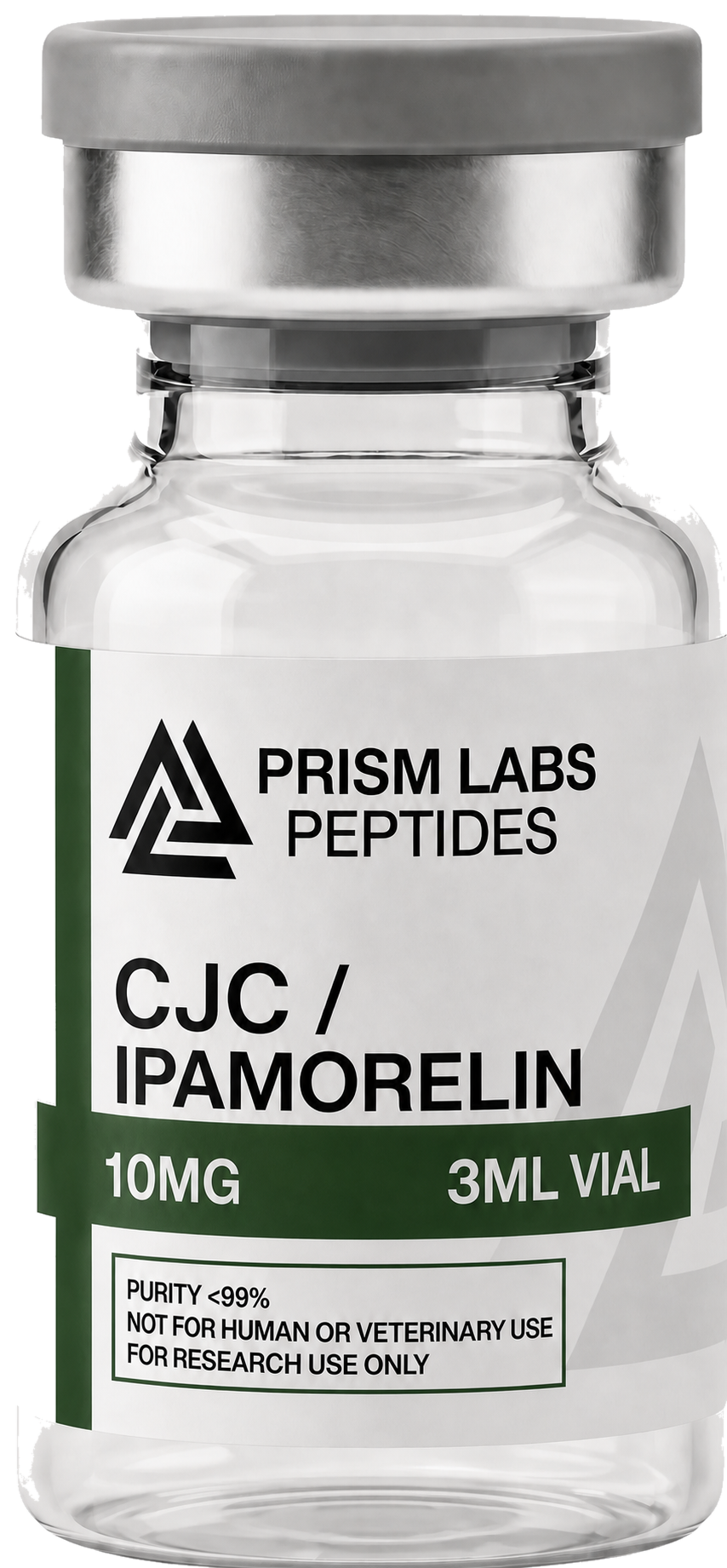
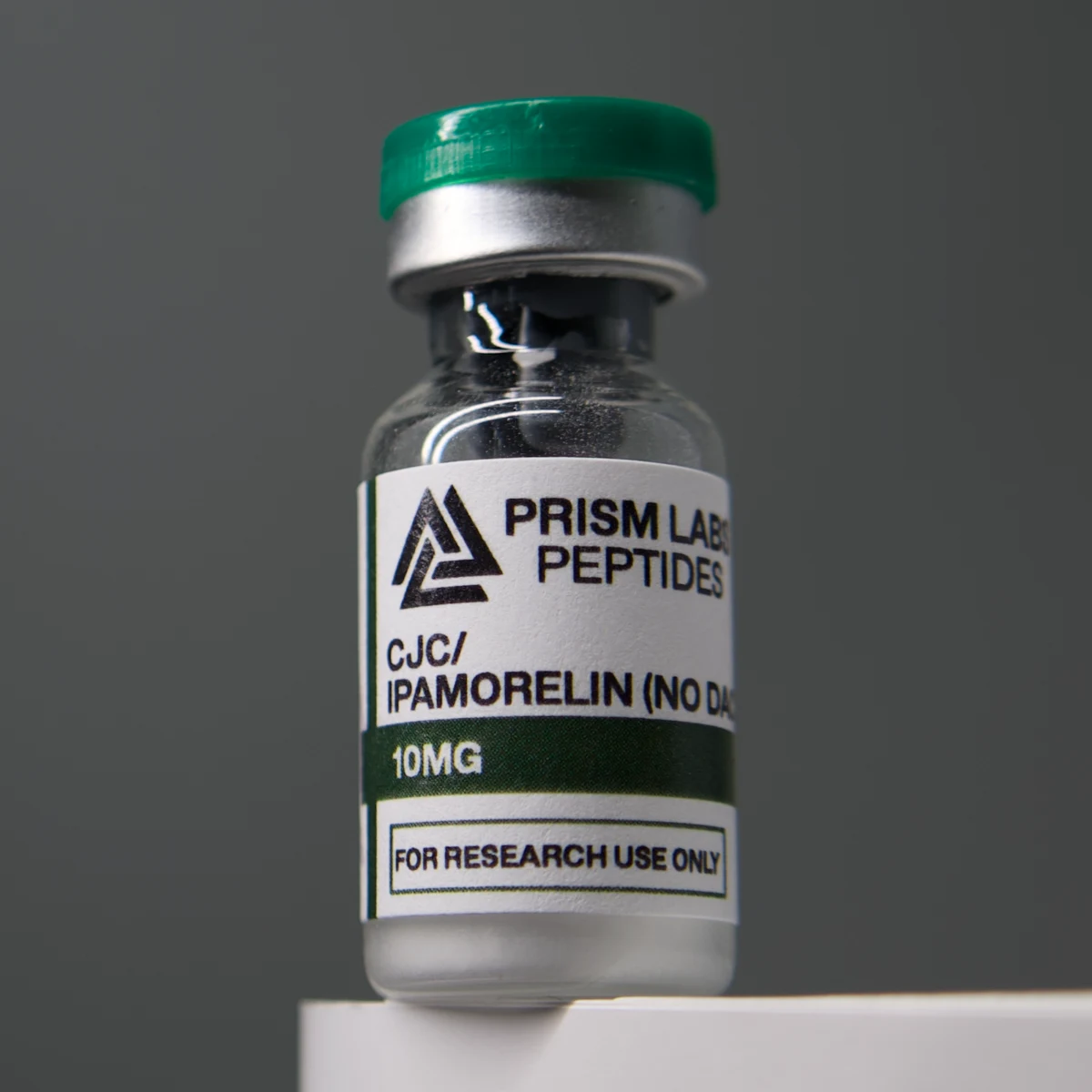
is a blend of two peptides in one vial: without DAC, a modified fragment of growth hormone-releasing hormone (GHRH), and , a five-residue growth hormone secretagogue. The two act on different receptors in the pituitary. Prism Labs supplies the blend as a lyophilized vial.
01
What’s in the blend
Two peptides from two research lineages:
- without DAC: a synthetic analogue built on the first 29 amino acids of GHRH, with several amino-acid substitutions.
- : Aib–His–D-2-Nal–D-Phe–Lys–NH2, a pentapeptide from a Novo Nordisk program, described in 1998.
As a blend, it has no single formula. The certificate of analysis for each lot reports the blend.
Sources: [4] Drug Testing and Analysis · 2021 · [5] European Journal of Endocrinology · 1998
02
What “No DAC” means
exists in two versions. DAC, short for drug affinity complex, is a reactive chemical group that attaches the peptide permanently to albumin in the blood.
In two 2006 studies, the DAC version stayed in circulation for about a week, with an estimated half-life of 5.8 to 8.1 days. The version without DAC lacks that group. Anti-doping chemists treat the two as separate compounds.
This blend uses the version without DAC. A label or COA that says “with DAC” describes a different compound.
Sources: [2] Journal of Clinical Endocrinology & Metabolism · 2006 · [3] Journal of Clinical Endocrinology & Metabolism · 2006 · [4] Drug Testing and Analysis · 2021
03
Two receptors, two pathways
is a GHRH analogue, so it acts on the GHRH receptor, the target of the natural hormone first sequenced in 1982.
acts on a different receptor, the one the growth hormone-releasing peptides use. In 1999 its natural ligand was identified as ghrelin, a 28-amino-acid peptide from the stomach.
The 1998 paper used GHRH and GHRP antagonists to show that the pentapeptide works through the GHRP receptor, not the GHRH one. Pairing one of each is the logic of the blend; no study cited here tested this specific blend.
Sources: [1] Science · 1982 · [6] Nature · 1999 · [5] European Journal of Endocrinology · 1998
04
What researchers have studied
Each component has its own literature:
- GHRH and its analogues: growth hormone and IGF-1 secretion.
- The pentapeptide: selective growth hormone release in rats and swine.
- Detection of GHRH analogues in anti-doping laboratories.
These are observations in laboratory models. They are not evidence about any use in people.
Sources: [2] Journal of Clinical Endocrinology & Metabolism · 2006 · [3] Journal of Clinical Endocrinology & Metabolism · 2006 · [5] European Journal of Endocrinology · 1998 · [4] Drug Testing and Analysis · 2021
06
How it is supplied and stored
ships as a lyophilized (freeze-dried) powder in 5 mg or 10 mg vials. The powder is stable at room temperature in transit. For lab use it is reconstituted with bacteriostatic water such as .
Concentration is total blend content divided by volume: 10 mg in 2 mL gives 5 mg per mL of combined peptide. The reconstitution calculator handles other combinations.
For storage before and after reconstitution, see how to store lyophilized peptides.
07
How to verify a batch
Every lot has its own certificate of analysis from an independent lab. Read three results separately:
- Identity: confirms the expected compound was detected.
- Purity: the share of the measured material that is the intended compound.
- Content: the amount measured, compared with the label.
Then match the lot number on your vial or bottle to the report, and use the report’s verification link to confirm it with the testing lab. Step by step: how to read a peptide COA.
A little more clarity
Questions, answered
What is / ?
A blend of two peptides: a GHRH analogue without DAC and a five-residue growth hormone secretagogue. They act on different receptors.
What does No DAC mean?
The blend uses without the drug affinity complex, a group that binds the peptide to albumin. The DAC version is a different compound.
What is DAC?
Drug affinity complex: a reactive group that attaches a peptide permanently to albumin in the blood. In 2006 studies it extended the analogue’s half-life to about a week.
Why are the two peptides paired?
They act on two different receptors: the GHRH receptor, and the receptor that ghrelin and the growth hormone-releasing peptides use.
Is it for human use?
No. Prism Labs sells it for laboratory research use only.
Follow the evidence
Sources & reading notes
Open the original record for its methods and limitations. The sources below do not certify the supplied product or its finished formulation.
- Science · 1982 ↗
The 44-amino-acid releasing factor and its sequence.
- Journal of Clinical Endocrinology & Metabolism · 2006 ↗
Pharmacokinetics of the DAC version in healthy adults.
- Journal of Clinical Endocrinology & Metabolism · 2006 ↗
Describes the DAC version’s permanent binding to albumin.
- Drug Testing and Analysis · 2021 ↗
Detection of four GHRH analogues, listing the versions with and without DAC separately.
- European Journal of Endocrinology · 1998 ↗
Development and selectivity of the pentapeptide.
- Nature · 1999 ↗
Discovery of ghrelin, the natural ligand of the second receptor.
Prepared by Prism Labs from the linked source records and public product documentation. Research context only; not a preparation protocol or a claim about outcomes. Send a source correction.
Keep exploring
More from the research library.
A four-peptide blend, taken apart component by component.
Read the article ↗Blends
Three peptides in one vial, taken apart component by component.
Read the article ↗Compounds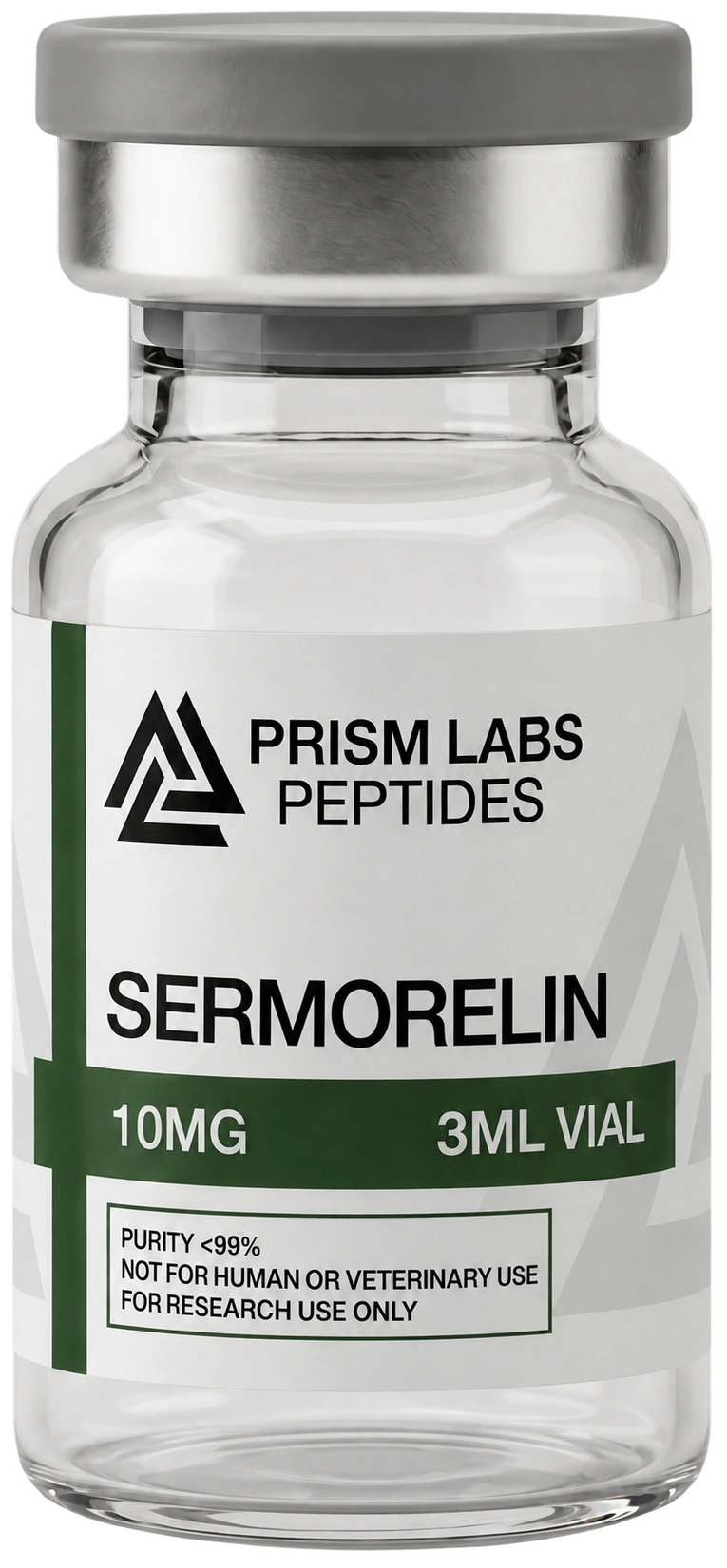
The first 29 of human GHRH’s 44 amino acids, with nothing added.
Read the article ↗