Research library / Compounds
What is peptide?
Three amino acids from the tail of α-MSH, studied as a peptide in their own right.
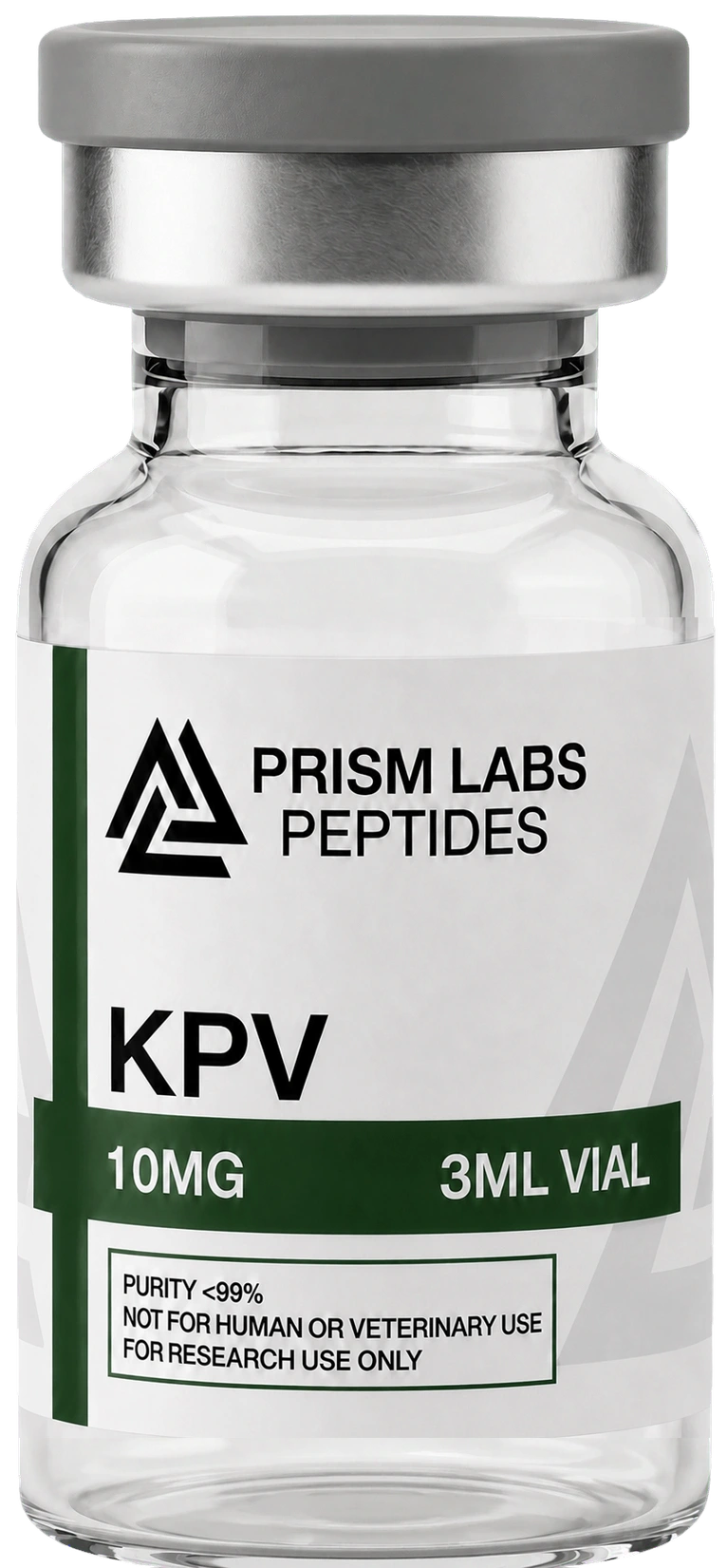
is a tripeptide, lysine–proline–valine: the last three amino acids of alpha-melanocyte-stimulating hormone (α-MSH), a 13-residue peptide hormone. It has been studied on its own because papers describe it as the smallest α-MSH sequence with anti-inflammatory activity in lab models. Prism Labs supplies it as a 10 mg lyophilized vial.
01
What it is
The sequence is Lys–Pro–Val, written in one-letter code, which is where the name comes from. PubChem lists it as α-MSH (11–13), with the formula C16H30N4O4 and a molecular weight of 342.43 g/mol (CID 125672).
α-MSH has 13 residues, and the tripeptide is its C-terminal end, positions 11 to 13. Some studies use a variant with D-valine (KP-D-V), a different stereoisomer, so check the identity result on your COA.
Sources: [1] PubChem · reference structure · [3] Journal of Investigative Dermatology · 2004
02
Where it came from
Interest in the tripeptide grew out of α-MSH research. A 2003 study separated the effects of the α-MSH core sequence (His–Phe–Arg–Trp) from those of the C-terminal tripeptide in mouse models.
A 2004 study in human skin cells (keratinocytes) found no rise in cyclic AMP, the messenger usually linked to α-MSH’s receptor, but did record calcium signaling under specific test conditions.
In 2008, two mouse studies of intestinal inflammation followed. One showed that intestinal cells take the tripeptide up through PepT1, a transporter for small peptides; the other included mice lacking a working MC1 receptor.
Sources: [2] Journal of Pharmacology and Experimental Therapeutics · 2003 · [3] Journal of Investigative Dermatology · 2004 · [4] Gastroenterology · 2008 · [5] Inflammatory Bowel Diseases · 2008
03
What researchers have studied
Most published work uses cell cultures and mouse models:
- Intestinal-inflammation models in mice, since 2008.
- Uptake through the PepT1 peptide transporter.
- Delivery systems: hyaluronic-acid nanoparticles in 2017 and a peptide-binding hydrogel in 2022.
- Signaling in skin cells.
These are observations in laboratory models. They are not evidence about any use in people.
Sources: [4] Gastroenterology · 2008 · [5] Inflammatory Bowel Diseases · 2008 · [6] Molecular Therapy · 2017 · [7] Acta Biomaterialia · 2022 · [3] Journal of Investigative Dermatology · 2004
04
Where else it appears
is the fourth component of , and the only difference between that blend and . See vs .
05
How it is supplied and stored
ships as a lyophilized (freeze-dried) powder in 10 mg vials. The powder is stable at room temperature in transit. For lab use it is reconstituted with bacteriostatic water such as .
Concentration is content divided by volume: 10 mg in 2 mL gives 5 mg per mL. The reconstitution calculator handles other combinations.
For storage before and after reconstitution, see how to store lyophilized peptides.
06
How to verify a batch
Every lot has its own certificate of analysis from an independent lab. Read three results separately:
- Identity: confirms the expected compound was detected.
- Purity: the share of the measured material that is the intended compound.
- Content: the amount measured, compared with the label.
Then match the lot number on your vial or bottle to the report, and use the report’s verification link to confirm it with the testing lab. Step by step: how to read a peptide COA.
A little more clarity
Questions, answered
What is peptide?
A tripeptide, lysine–proline–valine: the last three amino acids of α-MSH. It is studied in cell and mouse models of inflammation.
What does stand for?
The one-letter codes of its three amino acids: K for lysine, P for proline and V for valine.
Is the same as α-MSH?
No. α-MSH has 13 amino acids; the tripeptide is its last three, studied on its own.
Which blend contains ?
. It is the component that does not have.
Is it for human use?
No. Prism Labs sells it for laboratory research use only.
Follow the evidence
Sources & reading notes
Open the original record for its methods and limitations. The sources below do not certify the supplied product or its finished formulation.
- PubChem · reference structure ↗
Lys-Pro-Val, listed as α-MSH (11–13); not a measurement of the supplied batch.
- Journal of Pharmacology and Experimental Therapeutics · 2003 ↗
Separates the effects of the α-MSH core and its C-terminal tripeptide.
- Journal of Investigative Dermatology · 2004 ↗
Signaling of α-MSH, ACTH and the C-terminal tripeptides in human keratinocytes.
- Gastroenterology · 2008 ↗
Tripeptide uptake by intestinal cells through PepT1; mouse and cell models.
- Inflammatory Bowel Diseases · 2008 ↗
Two mouse models of intestinal inflammation, including mice lacking a working MC1 receptor.
- Molecular Therapy · 2017 ↗
Oral delivery in hyaluronic-acid nanoparticles; mouse colitis model.
- Acta Biomaterialia · 2022 ↗
A hydrogel that binds the tripeptide, tested in an inflamed-colon model.
Prepared by Prism Labs from the linked source records and public product documentation. Research context only; not a preparation protocol or a claim about outcomes. Send a source correction.
Keep exploring
More from the research library.
The first 29 of human GHRH’s 44 amino acids, with nothing added.
Read the article ↗Compounds
A lipid-linked peptide built to act on two related hormone receptors at once.
Read the article ↗Compounds
Part of the hormone α-MSH, rebuilt in 1989 as a cyclic seven-residue peptide to study melanocortin receptors.
Read the article ↗