Research library / Compounds
What is ?
A small molecule, not a peptide, built to block one enzyme in nicotinamide metabolism.
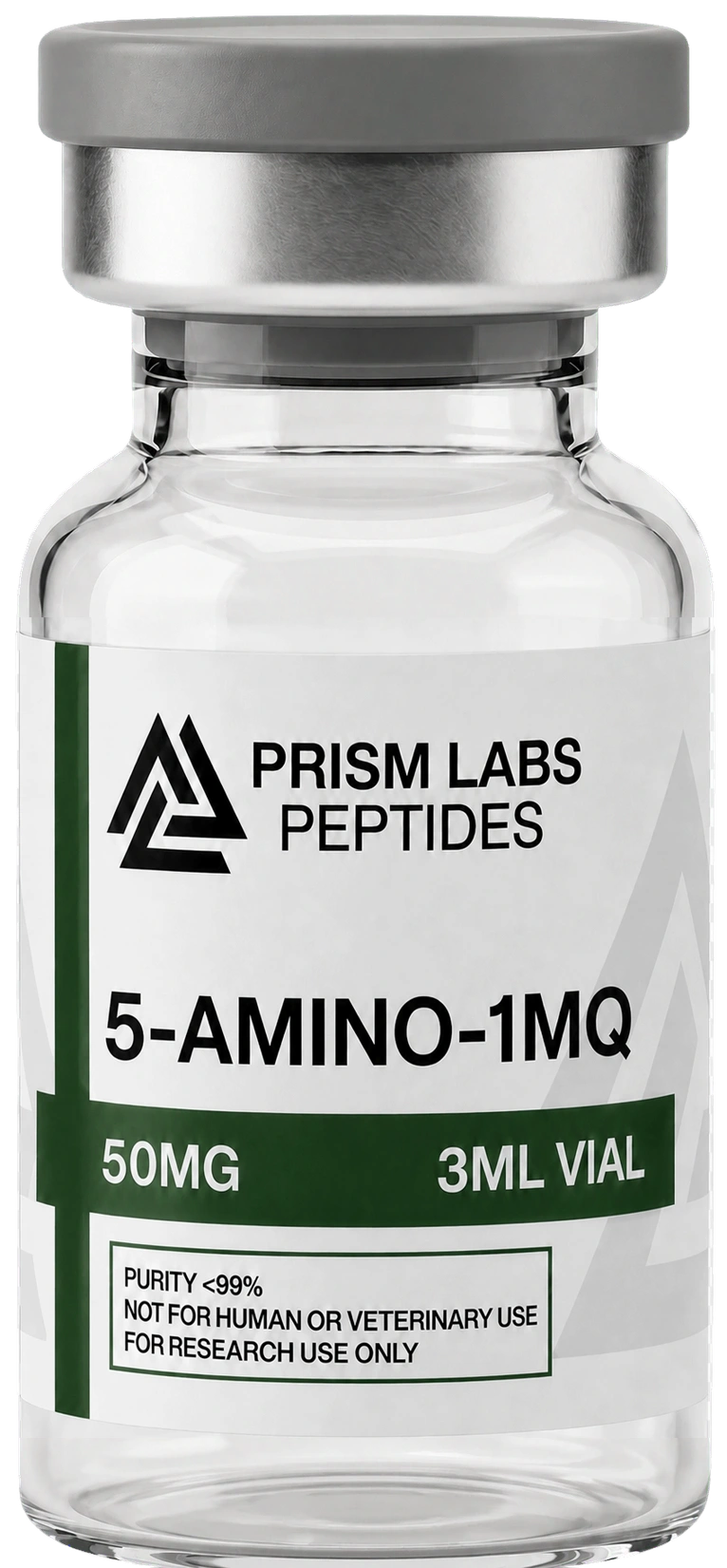
is a small molecule, not a peptide: 5-amino-1-methylquinolinium. It was designed to block NNMT, an enzyme that adds a methyl group to nicotinamide, a form of vitamin B3. Prism Labs supplies it as a 50 mg vial.
01
What it is
It is a quinolinium ion: a two-ring aromatic structure with a methyl group on the ring nitrogen and an amino group at position 5. The reference record lists the ion as C10H11N2+ with a mass of 159.21 g/mol (PubChem CID 950107).
Because it carries a permanent positive charge, it is supplied as a salt, and the counter-ion adds to the weight. Check the formula on the COA before doing concentration math.
Sources: [1] PubChem · reference structure
02
What NNMT does
Nicotinamide N-methyltransferase (NNMT) moves a methyl group from S-adenosylmethionine (SAM) onto nicotinamide, producing 1-methylnicotinamide. That reaction touches both the cell’s supply of methyl groups and the breakdown of nicotinamide, a building block of .
NNMT has drawn interest as a research target; a 2021 review covers how it works and the inhibitors designed against it.
Sources: [2] RSC Medicinal Chemistry · 2021 · [3] Biochemical Pharmacology · 2018
03
Where it came from
It belongs to a series of methylquinolinium NNMT inhibitors described in 2018 by a group at the University of Texas Medical Branch. In cultured fat cells, the inhibitors lowered the enzyme’s product and raised cellular levels of SAM and ; the paper also tested one in mice fed a high-fat diet.
A 2019 study from the same group examined an NNMT inhibitor and muscle stem cells in aged mice.
Sources: [3] Biochemical Pharmacology · 2018 · [4] Biochemical Pharmacology · 2019
04
What researchers have studied
Work so far is in enzymes, cells and mice:
- NNMT activity, and selectivity against related methyltransferases.
- Cellular levels of SAM, nicotinamide and its methylated product.
- Fat-cell and muscle-stem-cell models.
These are observations in laboratory models. They are not evidence about any use in people.
Sources: [3] Biochemical Pharmacology · 2018 · [2] RSC Medicinal Chemistry · 2021 · [4] Biochemical Pharmacology · 2019
05
How it is supplied and stored
It ships as a dry powder in a 50 mg vial and is dissolved in bacteriostatic water such as for lab use.
Concentration is content divided by volume: 50 mg in 5 mL gives 10 mg per mL. Use the salt weight from the COA, not the mass of the ion alone. The reconstitution calculator handles other combinations.
For storage before and after reconstitution, see how to store lyophilized peptides.
06
How to verify a batch
Every lot has its own certificate of analysis from an independent lab. Read three results separately:
- Identity: confirms the expected compound was detected.
- Purity: the share of the measured material that is the intended compound.
- Content: the amount measured, compared with the label.
Then match the lot number on your vial or bottle to the report, and use the report’s verification link to confirm it with the testing lab. Step by step: how to read a peptide COA.
A little more clarity
Questions, answered
What is ?
A small-molecule inhibitor of the enzyme NNMT: 5-amino-1-methylquinolinium. It is not a peptide.
Is a peptide?
No. It is a small quinolinium compound. It is sold alongside peptides and documented the same way, with a COA for each lot.
What is NNMT?
Nicotinamide N-methyltransferase, an enzyme that methylates nicotinamide using SAM as the methyl donor.
Why does the formula on the COA differ from PubChem’s?
PubChem lists the positively charged ion alone. Supplied material is a salt, so its formula and weight include a counter-ion.
Is it for human use?
No. Prism Labs sells it for laboratory research use only.
Follow the evidence
Sources & reading notes
Open the original record for its methods and limitations. The sources below do not certify the supplied product or its finished formulation.
- PubChem · reference structure ↗
The 5-amino-1-methylquinolinium ion; supplied salts add a counter-ion.
- RSC Medicinal Chemistry · 2021 ↗
Review of how NNMT works and the inhibitors designed against it.
- Biochemical Pharmacology · 2018 ↗
Methylquinolinium NNMT inhibitors in cultured fat cells and in mice fed a high-fat diet.
- Biochemical Pharmacology · 2019 ↗
An NNMT inhibitor and muscle stem cells in aged mice.
Prepared by Prism Labs from the linked source records and public product documentation. Research context only; not a preparation protocol or a claim about outcomes. Send a source correction.
Keep exploring
More from the research library.
The first 29 of human GHRH’s 44 amino acids, with nothing added.
Read the article ↗Compounds
A lipid-linked peptide built to act on two related hormone receptors at once.
Read the article ↗Compounds
Part of the hormone α-MSH, rebuilt in 1989 as a cyclic seven-residue peptide to study melanocortin receptors.
Read the article ↗